LUNOVA LEARNING CENTRE
Where light and sound work as one
A knowledge base exploring the science, design, and human benefits of acoustic lighting — the field that's quietly revolutionising how modern spaces feel.
50%+
of employees say poor acoustics hurt daily productivity
NRC 0.70
minimum recommended rating
for open-plan offices
2-in-1
lighting + sound absorption
in a single overhead fixture
100%
recycled PET felt used in
leading acoustic products
The science
behind it
Understanding NRC ratings, reverberation, and the acoustic physics that make these products work.Sound in a room: the basics
Every time a sound is made in an enclosed space, its waves travel outward and hit surrounding surfaces. Hard surfaces — glass, concrete, plasterboard — reflect almost all of that energy back into the room. As waves bounce repeatedly, they overlap and compound, creating reverberation: a smeared, sustained version of the original sound that makes speech harder to understand and spaces feel louder than they should.
Understanding NRC ratings
The Noise Reduction Coefficient (NRC) is the single most important number when specifying acoustic products. It measures how much sound energy a material absorbs, averaged across key speech frequencies (250 Hz, 500 Hz, 1,000 Hz, and 2,000 Hz). A value of 0.00 means the material reflects all sound; 1.00 means it absorbs all sound.
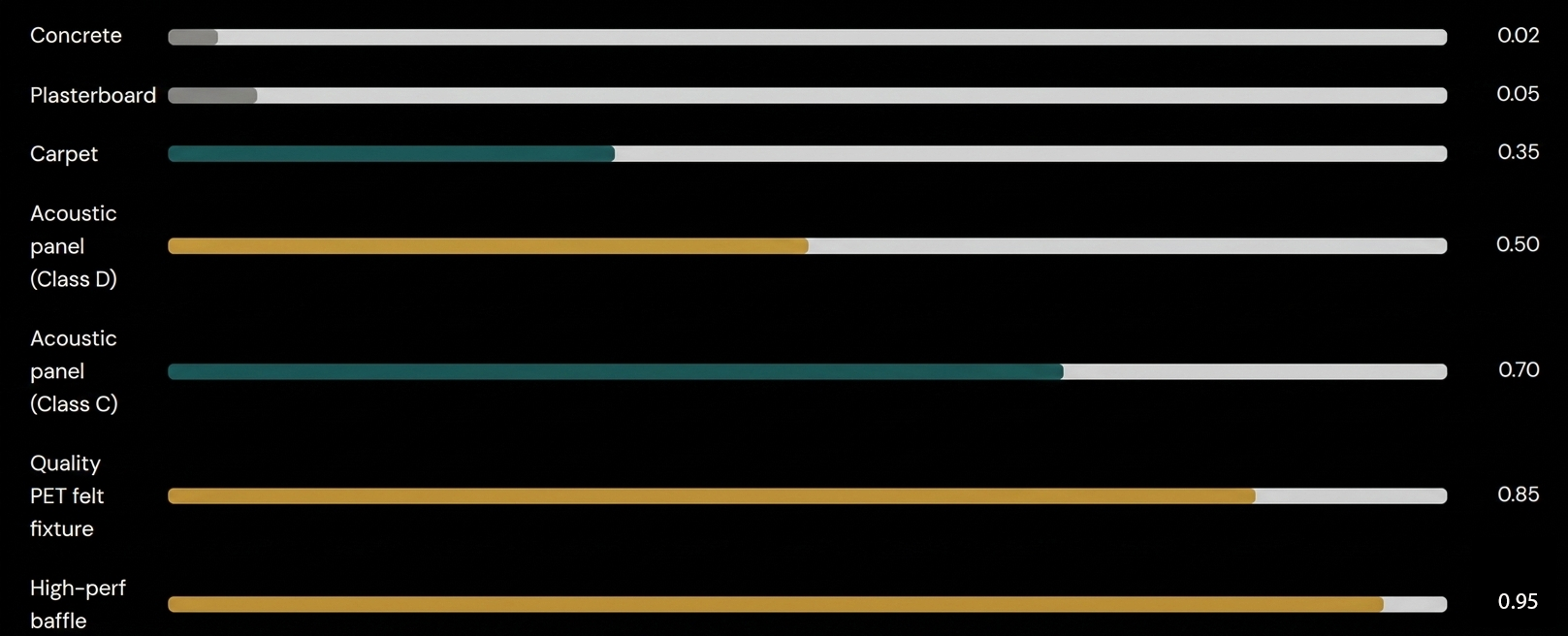
Target NRC 0.70–0.85 for open-plan offices and meeting rooms. Values above 0.85 suit spaces requiring maximum speech clarity. Testing follows ASTM C423 reverberation-room methodology. Luxxbox pendant lights have been independently tested to a minimum NRC of 0.45 (Class D) up to NRC 0.70 (Class C).
RT60 is the time it takes for a sound to decay by 60 decibels after the source stops. A shorter RT60 means a drier, clearer acoustic environment. Office spaces with too-long RT60 values (typically above 0.6 seconds for open plan) feel noisy and fatiguing even at moderate sound pressure levels.
Acoustic lighting placed in the ceiling plane — where reflective surfaces are hardest — is particularly effective at reducing RT60 because it intercepts sound before it can undergo multiple reflections.
What is reverberation time (RT60)?
How PET felt works
Recycled PET (polyethylene terephthalate) felt is an open-cell, fibrous material. When sound waves enter its surface, the fine fibres convert the wave's kinetic energy into a negligible amount of heat through friction. This dissipation prevents sound from being reflected back into the room.
PET felt's porous structure makes it particularly effective at mid-range frequencies — exactly the frequencies of human speech — making it an ideal material for office acoustic solutions.
Key acoustic materials at a glance
MATERIAL
TYPICAL NRC
COMMON USE
Recycled PET Felt 0.65 - 0.95 Pendant lights, baffles, wall panels 100% Recycled Recyclable
Acoustic Wool 0.60 - 0.90 Premium fixtures, wall upholstery Biodegradable Natural Fibre
Polyester Short Fibre 0.55 - 0.86 Ceiling panels, baffles Recyclable
Acoustic Foam 0.50 - 0.80 Studio treatment, pods Varies by Product
Mycelium-Based Panels 0.55 - 0.80 Feature panels, cutting-edge installations 100% Grown Compostable
SUSTAINABILITY
SUSTAINABILITY
SUSTAINABILITY
SUSTAINABILITY
SUSTAINABILITY